


The scope was to see if it was possible to reach the severest environmental limits (in this case the German normations) with a relative simple process.
The total annual capacity of the incinerators is around 51,000 tonnes of waste.
Constructed in 1968, the incinerator has been upgraded several times:
The dustfree fumes thereafter are thoroughly mixed with fine milled sodium bicarbonate and active carbon, direct in the gas line.
The sodium residues (NaCl + Na2SO4 + Na2CO3), resulting from the neutralisation of the acid contents of the gas are separated in a second filtration system, realised by bag filters.
The activities mainly were based on taking samples and succesive analyses of the main components. The sampling was effectuated at three points in the gas line. The following figure gives a general scheme of the incinerator and the location of the sampling points.
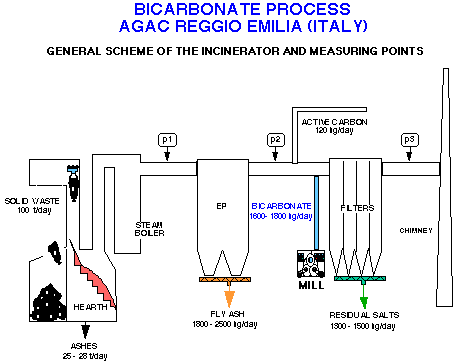
The analyses of gas composition for the determination of HCl, SOx, NOx, O2 and CO content at the points P2 and P3 was performed by online IR emission spectrophotometers type MIR 9000.
To analyse other elements and compositions, ad hoc sampling was performed, followed by analyses at the DCO/LP laboratory.
The sampling apparatus was made for the sampling of the three phases, solids, condensables and non-condensable gases. To determine the total contents of micro-elements, it is necessary to examine all three phases separately. The sampling time was app. 10 hours, to allow the collection of a sufficient amount for the following analyses. For the organic microcontaminants, 24 hours of sampling time were necessary.
For the dioxin analyses, a massa spectrometer was coupled with the gas chromatograph (GCMS), For the analyses of inorganic micropolluants was used a plasma mass spectrometer (ICP-MS) was used, a plasma mass spectrometer with atomic emissions (ICPAES), an atomic absorption spectrometer with hydrogen generation (FIHGAAS) and an ion chromatograph (IC).
The detection limits of the analytical techniques used were:
| Be, Cd, Co, Cr,
Cu, Mn, Ni, Pb, Hg, Sb |
0.003 µg/Nm3 |
|---|---|
|
As, Se, Sn |
0.03 µg/Nm3 |
| dioxins
and furans |
0.08 ng/Nm3 |
| Polluent
mg/Nm3 11%O2 |
At the entrance
of the cleaning system |
Emissions after
the bicarbonate process |
German
normation 17a BIm Sch V of 1990 |
D.M. 12/7/90
(Italian legislation) |
|---|---|---|---|---|
| Particulates | 2-7 | 10 | 30 | |
| HCl | 1070 | < 5 | 10 | 50 |
| HF | 4 | < 0,02 | 1 | 2 |
| HBr | < 0,04 | < 0,04 | 5 | |
| HCN | 0,002 | < 0,001 | not normated | |
| SOx | 150 ± 20 | 1-18 | 50 | 300 |
| NOx | 140 ± 20 | 130 ± 20 | 200 | not normated |
| Substances
Class 1.1 |
49x10^-6 | 0,1 | 0,1 | |
| As+Co+Ni | 0,036 | 0,009 | 1 | 1 |
| Se + Te | 7x10^-3 | 0,1x10^-3 | 1 | |
| Cd + Tl | 0,211 | 0,5x10^-3 | 0,05 | (+Hg) 0,2 |
| Hg | 0,54 | 0,009 | 0,05 | |
| Sb +Cr +Mn +Pb
+Cu +Sn +V |
7,05 | 0,0029 | 1 | 5 |
| PCDD/F
mg/Nm3 11%O2 ng/Nm3 (TE NATO) 11% O2 |
0,3 x 10^-4
0,95 |
0,6 x 10^-6
0,085 |
0,1 |
0,004 |
You are at level three of the Chlorophiles pages.
Created: May 3, 1997.
Last update: September 8, 2001.
 To the Home Page of the Chlorophiles
 Chlorine input and dioxin output at incineration
For any comment on the AGAC Reggio Emilia (Italy) incinerator or on other Chlorophiles pages:
 chlorophiles@pandora.be

